

The continent has produced some of the world’s most potent cultural exports — music, fashion, philosophy, sport, cuisine. It has built companies that move billions. And yet African brand thinking remains largely pointed at consumption rather than transformation. Something is being left on the table. This is an attempt to name what it is.
Let us start with something true and uncomfortable: Africa’s most persistent problems are not, at their root, resource problems. They are perception problems. They are behaviour problems. They are trust problems. And brand — real brand, brand as a strategic discipline rather than aesthetic exercise — is one of the most powerful tools humanity has ever developed for changing perception, shaping behaviour, and building trust at scale.
So why are we not using it that way?
The honest answer is that we have been using it, just mostly for other people’s benefit. The global brand machine learned very early that Africa was a market. It sent its products, its logos, its aspirational imagery, and its distribution networks. In return it extracted loyalty, margin, and cultural influence. African consumers became fluent in brands that were never built with them in mind, and in many cases were actively built against their interests.
That story is changing. But it is changing slower than it should, and in a narrower direction than it could.
Much of what passes for African brand building today is, in structure and ambition, an imitation of what was done to us. We have learned the vocabulary — positioning, identity, experience design, storytelling — and we are applying it competently to the task of selling things. That is not nothing. A continent of 1.4 billion people developing its own commercial brand culture is genuinely significant.
But imitation has a ceiling. And we are approaching it.
The brands that will matter most in the next twenty years will not be the ones that best replicate a Western model for an African market. They will be the ones that use brand thinking to solve problems that no Western model was designed to solve — because those problems were not considered, or were considered irrelevant, or were considered someone else’s burden.
“We have 3,000 languages, 54 governments, and centuries of storytelling tradition that has never been fully monetised, codified, or exported on our own terms. That is not a liability. That is the largest untapped brand asset on earth.”
Three problems that brand can solve — and isn’t
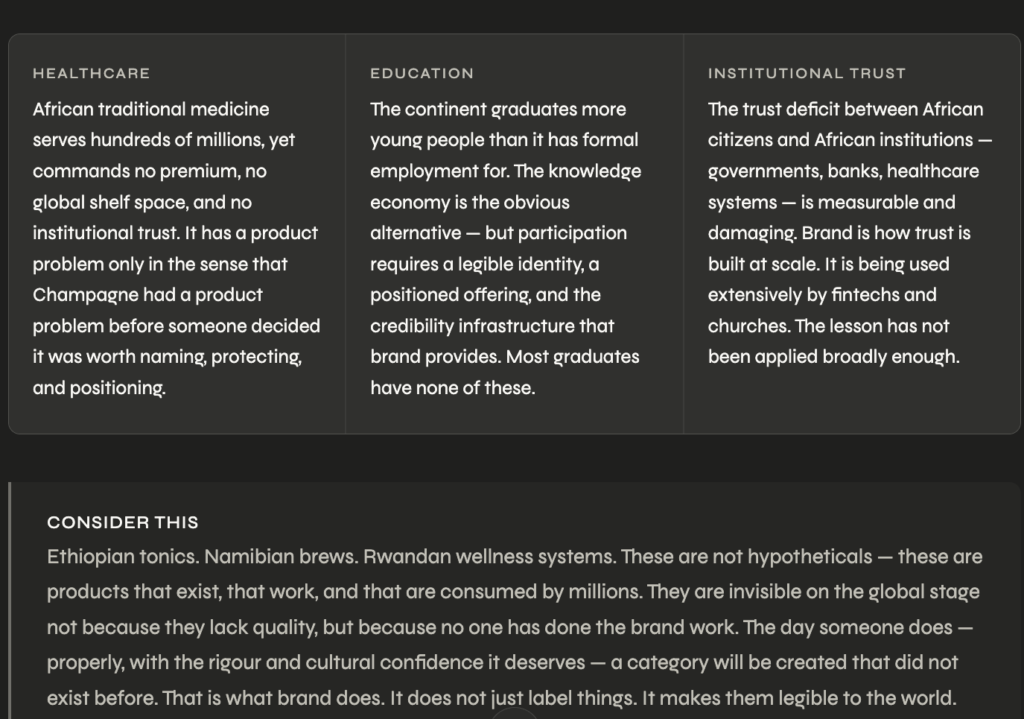
The collaboration deficit
Here is a number worth sitting with: 54 countries. One continent. How many genuinely pan-African brand collaborations can you name? Not co-branded campaigns. Not regional extensions of a single national brand. Actual creative and commercial partnerships that treat Africa as a single strategic theatre and build accordingly.
The number is embarrassingly small. And this is not a political observation — it is a strategic one. The most powerful brands in the world derive part of their power from operating at a scale that no single competitor can easily replicate. Africa has the scale. It is simply not organised around it.
The barriers are real: currency friction, regulatory fragmentation, infrastructure gaps, and decades of colonial borders that were drawn to divide rather than connect. We know all of this. But we have, in the creative and brand community specifically, been too willing to accept those barriers as permanent rather than treating them as the design problem they actually are.
Every constraint is a brief, if you are willing to read it that way.
What the next chapter looks like
The brands that will define Africa’s next era are not going to emerge from the usual centres. They will not look like scaled-down versions of global firms. They will be built on cultural assets that this continent owns outright — oral tradition, communal identity, the philosophy of Ubuntu, an aesthetic vocabulary that the rest of the world is actively borrowing without attribution or compensation.
They will be built by people who understand that brand is not decoration applied after the strategic decisions have been made. It is the strategic decision. Perception precedes everything — investment, partnership, talent, trust. A continent that controls its own perception controls its own future.
We are not there yet. But we are closer than the conversation usually admits. The creative infrastructure exists. The cultural raw material is extraordinary. What is missing is not resources — it is resolve. The willingness to treat brand not as a cost of doing business, but as the most powerful instrument of transformation we have access to.
Brands will save Africa. We just need to start building them like we believe it.